TEXTILES ~ SOUTH AMERICA
Creatures and Captives: Painted Textiles of the Ancient Andes


For centuries, ancient Andean artists painted animals, humans, abstract motifs, and mythical beings on undyed cotton cloth. Showcasing a subtle color palette, these painted textiles have long been overshadowed by textiles woven from brightly dyed cotton and woolen yarns. Creatures and Captives: Painted Textiles of the Ancient Andes presents examples from the DMA’s collection highlighting this lesser-known Andean textile tradition, and features exciting new research carried out through institutional collaborations.
Creatures and Captives: Painted Textiles of the Ancient Andes is organized by the Dallas Museum of Art. The Dallas Museum of Art is supported, in part, by generous DMA Members and donors, the Texas Commission on the Arts, and the citizens of Dallas through the City of Dallas Office of Arts and Culture.
LOCAL SUPPORT

Images: Fragmentary Panel of the Prisoner Textile, 1200–1290. Chimú peoples. Peru, South America. Cotton, pigment, or dye. Dallas Museum of Art, the Nora and John Wise Collection, bequest of Nora Wise, 1989.W.1906; Painted Cloth: Standing Frontal Figures Holding Knives and Trophy Heads, about 1300–1476. Chancay. Peru. Cotton, pigment, or dye. Dallas Museum of Art, the Nora and John Wise Collection, bequest of John Wise, 1983.W.1917; Fragmentary Painted Cloth: Serpent-Head Motif, about 1000–1476 CE. Central or North-Central coast, Peru. Cotton, pigment, or dye. Dallas Museum of Art, the Nora and John Wise Collection, bequest of John Wise, 1983.W.1913.
Boshell Family Lecture Series on Archaeology: Fragmented Mysteries: The History of the Prisoner Textile
Dig into history with us as we explore one of the largest and most formidable ancient textiles ever discovered: the Prisoner Textile. In conjunction with the DMA's exhibition Creatures and Captives: Painted Textiles of the Ancient Andes, three scholars will come together to present exciting new research on this 700-year-old Chimú artwork. The exhibition celebrates collaboration between conservators and curators at the DMA and Houston’s Menil Collection, two museums that steward fragments of the originally 75-foot-long painting from the coast of Peru. The exhibition wraps on February 22, so join us as we send it off in style!
This talk features Dr. Michelle Rich, The Ellen and Harry S. Parker III Associate Curator of Indigenous American Art at the DMA; Dr. Cory Rogge, Director of Conservation at the Menil Collection; and Kari Dodson, Objects Conservator at the Menil Collection.
A pre-lecture musical performance of traditional Peruvian music by Peruvian-American guitarist Pepe Valdez will take place on Level 3 in the textile gallery from 1:45 to 2:30 p.m..
Michelle Rich, PhD, is The Ellen and Harry S. Parker III Associate Curator of Indigenous American Art. Since joining the DMA in 2018, she has been working to highlight the depth and diversity of Indigenous art across the Americas through exhibitions, publications, and gallery installations. Her curatorial practice bridges archaeology, art history, and museum work, with a focus on rigorous scholarship and amplifying Indigenous voices. She edited The Arts of the Ancient Americas at the Dallas Museum of Art, a 360-page catalogue featuring new research and over 100 new photographs of highlights from the DMA’s Indigenous American art collection. She is currently developing an exhibition about Maya women that features both ancient and contemporary art. Dr. Rich holds a PhD in Archaeology from Southern Methodist University and has been affiliated with the US-Guatemalan Proyecto Arqueológico El Perú-Waka´ since 2003.
Dr. Corina (Cory) Rogge, PhD, is the Director of Conservation at the Menil Collection and President of the American Institute for Conservation. She earned a BA in Chemistry from Bryn Mawr College and a PhD in Chemistry from Yale University, and held postdoctoral positions at the University of Wisconsin–Madison and the University of Texas Health Sciences Center (Houston). Before joining the Menil Collection full time in the summer of 2023, she served as the Andrew W. Mellon Research Scientist at the Museum of Fine Arts, Houston (2013–2023) and the Andrew W. Mellon Assistant Professor in Conservation Science in the Department of Art Conservation at State University of New York Buffalo State College (2010–2013). While much of her research focuses on 20th-century artists, paints, and pigments, she works on materials across all cultures, media, and ages.
Since 2014 Kari Dodson has been an objects conservator at the Menil Collection in Houston. She especially enjoys technical art historical research and using innovative imaging techniques to make visible the invisible. She has held internships and fellowships at the Worcester Art Museum, the Metropolitan Museum of Art, the Barnes Foundation, and the National Museums of Malawi. Before landing on a career in conservation, she taught ESL, worked on archaeological digs, and was employed at a nuclear reactor.
Learn more about the technical analysis of the textiles in the Creatures and Captives: Painted Textiles of the Ancient Andes Exhibition Journal PDF download.
This series is supported by the Boshell Family Foundation and the DMA’s Boshell Lecture Series Endowment Fund.
To request accessibility accommodations such as ASL interpretation, gallery stools, or wheelchairs, please send an email to access@dma.org.
Andrew James Hamilton, Ph.D., is the Associate Curator of Arts of the Americas at the Art Institute of Chicago, specializing in Andean art, textiles, and colonial Latin American art. He stewards ~2,000 indigenous objects, focusing on research, the Gaffron/Cummings collections, and contemporary Native art. He authored Scale & the Incas (2018) and The Royal Inca Tunic (2024).
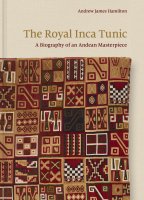
The Royal Inca Tunic: A Biography of an Andean Masterpiece

CHIMU
Sheila Hicks and Ancient Andean Textiles Intertwine at the Dallas Museum of Art
Textile artist and abstractionist Anni Albers once wrote, “Along with cave paintings, threads were one of the earliest transmitters of meaning.” From beautiful ornamental pieces destined for display to more functional articles worn daily, textiles were elemental components of daily life for bygone peoples, especially those across South America. Inspired by the ancient artifice, 84-year-old fiber artist Sheila Hicks began to incorporate the discipline into her own works and has done so for about 60 years. In a captivating display of colored threads and texture, the Dallas Museum of Art presents Sheila Hicks: Secret Structures, Looming Presence, a knit of contemporary and ancient indigenous weaving techniques.
Although based in Paris since 1964, Hicks has lived and worked extensively in various South American countries, including Mexico, Peru, and Chile. During her time abroad as a student specifically, Hicks discovered her interest in ancient Andean textiles as she was conducting research on the subject for her master’s thesis. This academic interest turned artistic and personal when she began weaving herself.
“In my conversations with Hicks, she told me with joy in her voice that she didn’t want to just ‘study’ things. She wanted to make them,” says Michelle Rich, the Ellen and Harry S. Parker III assistant curator. “I found that very profound and really spoke to Sheila’s level of creativity and her ability to appreciate the skill and craftsmanship of artisans from the past and bring that into the present and translate it in a new a different way.”
Detail of Zihzabal (2018).
The exhibition begins up the stairs on the fourth floor, in the Atrium Overlook. Take a look at the few Hicks pieces adorning the walls on either side of the entrance to the Art of the Americas gallery before heading inside. Upon entering the gallery’s second room, you will be greeted by an apt display.
Hanging from the wall are three Hicks pieces. Protected under the display case are four from the Nora and John Wise Collection of Ancient South American Art. Though created thousands of years apart and by a number of different hands, some similarities stand out. The four-salvage panel–an ancient weaving technique used to ensure the piece has four finished edges–appears in Hicks’ smaller pieces, which she calls “minimes.”
Wrapping and bundling, another Andean staple, manifests in Zihzabal. With this piece, Hicks plays as much with depth as she does with texture. Spools of colorful twine envelop several bamboo skewers, and while some lay prevalent in the foreground, others peak out from their fiber dens, physically parting curtains of thread as they do so. This playful work stands apart from the exhibition, thanks to both its vibrant appearance and to its recent purchase by the DMA. Zihzabal will be the first Hicks in the Museum’s collection, coming shortly before Hicks’ surprise donation of another woven piece.
In some ways, viewing these Hicks pieces alongside Andean artifacts feels like seeing her work as it was meant to be seen. In this exhibition, the viewer is given an extra contextual thread, one which emphasizes both the artist’s veneration for the works of weavers past and the undeniable cultural nuance of the discipline.
Sheila Hicks: Secret Structures, Looming Presence is on view until January 12, 2020. Admission is free, and while you’re there, check out another focus show you won’t want to miss.

“It was easy for us to fall in love with Sheila,” says Pier Luigi Loro Piana, deputy chairman of his family’s fashion company, referring to the artworks Sheila Hicks created with Loro Piana’s trademark strands. “She’s able to create sculptures as well as pictures that transmit emotion. It’s what art is all about.” The series of linen yarn paintings—or “chainettes,” as Hicks calls them—along with her soft stone sculptures (three-dimensional disks wrapped in yarn) incorporate her practice of braiding, twisting, stitching, wrapping, revealing and enhancing warp threads, woven with the artisan fibers that highlight her signature oeuvre.
The artist’s tactile weavings and sculptures were featured this spring at her newest solo show in Italy at Galleria Massimo Minini, and the commissioned weavings for Loro Piana were displayed at the MiArt contemporary art fair in Milan in April. Hicks also recently showed at the 20th Biennale of Sydney, the Tate Modern, the Joslyn Art Museum in Nebraska, the Textile Museum in the Netherlands, Paris’ Musée Carnavalet and the Hangzhou Triennial of Fiber Art.
Hicks’ predilection for installation and textile art dates back to Yale in the 1950s, when she studied with painter and color theorist Josef Albers and George Kubler, an art historian who was an expert in Pre-Columbian and Spanish colonial work. There, the Nebraskan reconnected with knitting, weaving, sewing and embroidery, all skills she’d acquired from older female relatives back home.
A Fulbright fellowship transported Hicks to Chile, where she studied local crafts and weaving techniques, resulting in a series of miniature weavings called “minimes,” which remain relevant to her work today. After Yale, Hicks headed to Mexico before settling in Paris, where she’s lived and worked for the last 52 years.

The 1960s was a fertile period with her collaboration with furniture manufacturer Knoll. Contracts with architects and designers for commissions included rugs for the newly opened CBS Building (1965), designed by architect Eero Saarinen, and bas-reliefs installed in Kevin Roche’s Ford Foundation headquarters (1967). “When you have something like the Ford Foundation in New York that can last 40 years, it feels good that people can live with it, use it, and keep discovering it, with new generations coming and going. It must be the feeling architects have,” Hicks, 82, says about her life’s work.
The Loro Piana threads are not your run-of-the-mill textiles. They are produced from the rarest sources, the most precious and costly being the soft hairs extracted from the vicuña that roam freely in the Peruvian wild. The underfleece of Hircus goats raised in China and Mongolia yield baby and fine cashmere, while Australia and New Zealand provide the majority of merino wool. The most exotic are lotus flowers from Myanmar, whose stems are woven into hand-made yarn. “For us it’s normal to use linen, cotton, wool and mohair. It’s unusual to see somebody who considers that as raw material for art,” says Loro Piana about Hicks’ weavings.

The production of the highly coveted threads takes hours of handiwork. From the moment they’re shipped to the mill in Northern Italy, they’re combed and sorted, twisted, spun, and then wound into the finest of yarns. “We are not trying to build a name in order to use it to sell things. We try to stay very focused on what the product itself can mean for our customer,” says Loro Piano about the heritage cashmere company launched as a wool manufacturer in 1924. This fall, a new store opened in the Miami Design District, highlighting Loro Piana’s commitment to fusing art, fashion and design. For Pier Luigi Loro Piana, luxury is an allusive pursuit. “To me, actually, it is when you are looking and when you are
near to quality, without compromise,” he says.


Comments
Post a Comment